
The Appliance Parts Liquidator: Selling the “Brains” of the Machine
We’re looking at the big appliance pile today. If you’ve been running a route, you know that refrigerators, washers, and dryers are the most common things you’ll find on a curb. Most folks in this trade treat an old washing machine like a big, hollow box of “light iron” or “shred” steel. They haul that heavy beast to the yard, wait in line, and get a check for maybe fifteen dollars.
If that’s your game, you are doing a lot of heavy lifting for the smallest slice of the pie. The problem with traditional appliance scrapping is the volume-to-value gap. You fill your truck with two refrigerators and a dryer, and your suspension is screaming. You spend your gas and your time moving three hundred pounds of steel just to get a payout that barely covers your lunch for the day. It often feels like you are a professional mover who happens to get paid in scrap prices.
To the master of the yard, an appliance isn’t just steel – it is a housing for high-value components. There is a world of buyers called Appliance Parts Liquidators who don’t want the steel shell at all. They want the “brains” and the “muscle” inside, and they will pay you more for a single circuit board than the scrap yard pays for the whole machine. You’re leaving the most expensive parts in the shredder because you don’t have a seat at the table with the repair industry.
The solution is to find an Appliance Parts Liquidator or a “Core Buyer” for white goods. These are specialized wholesalers who purchase used, functional components to sell to repair technicians and refurbishment shops. They don’t look at a dryer as scrap; they look at it as a source for timers, heating elements, and sensors. By “harvesting” the high-value parts before you scrap the shell, you turn one fifteen-dollar machine into a sixty-dollar payday. You stop being a heavy-lifter and start being a parts supplier.
What is an Appliance Parts Liquidator?
In the business, these buyers are known as “Parts Wholesalers” or “Recovery Specialists.” They fall under NAICS 423620 (Household Appliance Merchant Wholesalers). Their job is to supply the repair market with affordable, tested alternatives to brand-new factory parts.
Manufacturers often stop making parts for machines that are only ten years old. This creates a massive secondary market for “NLA” (No Longer Available) components. A liquidator looks for four main “tiers” of parts:
- Control Boards: The “brains” of modern machines. These are high-value because they are expensive to buy new and easy to ship.
- Motors and Pumps: The “muscle.” Washers and dishwashers have heavy-duty motors that carry a high resale value.
- Timers and Switches: In older, mechanical machines, these are the parts that fail most often.
- Ice Makers and Valves: Specialized components in refrigerators that are universal and always in demand.
How to Find and Work with a Parts Liquidator
You won’t find these buyers at the local scrap yard. You need to look for “Used Appliance Parts Distributors” or “Appliance Core Recovery” firms. Companies like Marcone or Reliable Parts are the giants in the new-parts world, but there are regional liquidators who focus entirely on the “used and tested” market.
When you call a liquidator, don’t ask if they “buy junk.” Ask for their “Buy-Back List for Tested Electronic Modules.” To get the top dollar, you need to understand their “In-Gate” requirements:
- Part Numbers: Every board and motor has a sticker or a stamp. The buyer needs that number to know what it fits.
- Model Numbers: Before you pull a part, take a photo of the “Model and Serial Number” tag on the machine itself. A pro liquidator wants to know the “source” of the part.
- Condition: They don’t want “melted” boards or “seized” motors. They are buying items that can be put back to work.
Starting an Appliance Parts Business
If you want to move beyond the scrap route, you can build a parts-recovery shop in your own garage. This is a high-margin business with very low overhead.
The Setup:
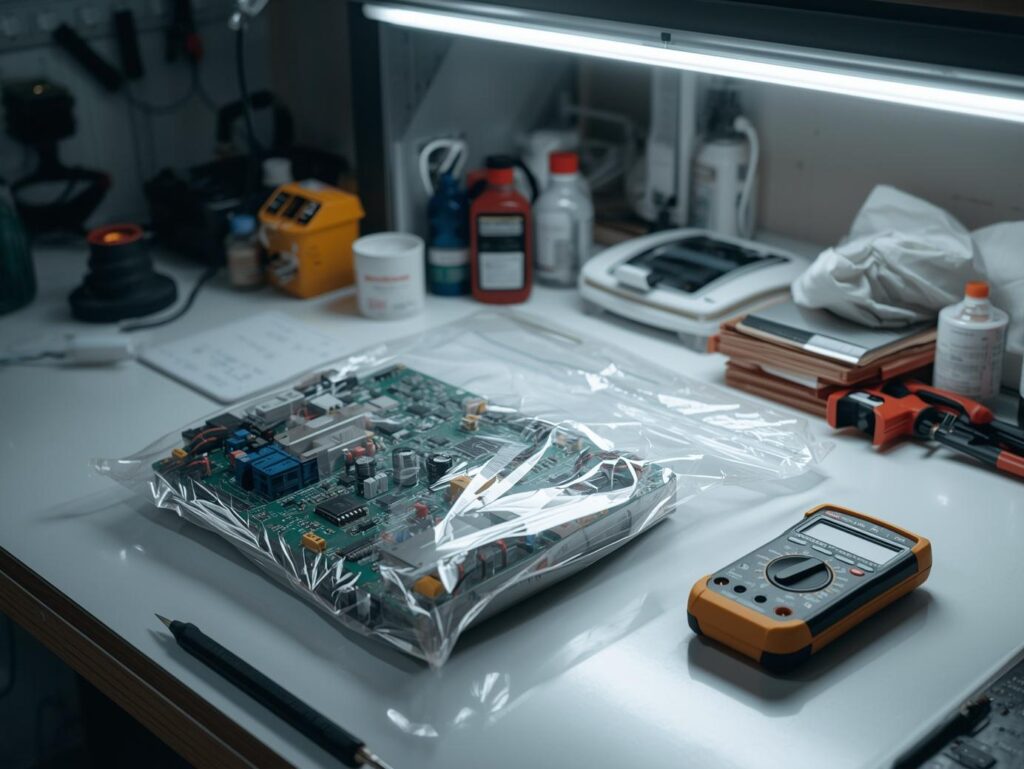
- The Space: You need a dry, organized area with plenty of shelving. You also need a workbench with “ESD” (Electro-Static Discharge) protection if you are handling circuit boards. Static electricity can kill a board before you even list it for sale.
- The Tools: You need a high-speed impact driver with a set of nut-drivers (1/4″, 5/16″, and 7/16″ are the big ones). You also need a “Multimeter” to test for continuity. If a part doesn’t pass a basic electrical test, it stays in the scrap bin.
- The Inventory: Use “Anti-Static” bags for all electronic boards. Label every part with the model number and part number immediately. In this business, an unlabeled part is just a piece of e-waste.
- The Payout: This is about “Labor-to-Profit.” It takes five minutes to pull a control board worth $40. It takes an hour to haul the steel shell worth $10. You do the math.
The “Secret Sauce”: The “Visual Burn” Inspection Tip
I want to give you a tip that will save you from wasting time on “junk” boards. This is what the pros look for before they ever put a tool to a screw.
Did you know? Most appliance control boards fail because of a “Voltage Spike” or a “Short Circuit.” When this happens, it leaves a physical mark that you can see if you know where to look.
The Tip: Before you pull a board, take a high-powered flashlight and look at the “Relays” (the little black or clear boxes on the board) and the “Resistors.”
- Look for “Ghosting” – a faint, smoky grey residue on the board. This indicates a component “let the smoke out.”
- Look for “Cold Solder Joints” – if a solder point looks dull and cracked instead of shiny, the part is likely intermittent and should be scrapped.
- The Pro Move: Smell the board. If it has a sharp, ozone, or “burnt plastic” smell, don’t waste your time. That board is a “dud.” By doing a ten-second visual and “sniff” test, you ensure that every part you warehouse is a winner.
Integrity and the Trade
In the parts business, your reputation is built on “Functionality.” If you sell a part as “tested and working,” it better work. If you sell a dud to a liquidator, they might give you a pass once, but if it happens again, you’re out.
Play it straight. If you didn’t see the machine run before you scrapped it, list the part as “Untested/As-Is” or sell it to a “Refurbisher” who has the gear to test it. Being the person who provides “Reliable Core Stock” is how you get the best prices.
Always check your local laws. Some states have “Secondhand Dealer” laws that require you to hold parts for a certain period to prevent the sale of stolen goods. Keep your records clean and follow the rules.
***
Ulysses’ Safety Reminder: Appliances are dangerous. Capacitors in microwaves and some dryer motors can hold a lethal electrical charge for days after being unplugged. Always “discharge” a capacitor with a specialized tool before touching the terminals. Also, watch for “Sharp Edges.” The sheet metal on a modern washer is as sharp as a razor once you peel it back. Wear your “Cut-Level 5” gloves and keep your tetanus shots up to date. Stay sharp and stay safe.
Specialist Scrap Buyers
Knowledge is the only thing that doesn’t weigh down the truck.
- Gold and Silver Refiners: Skip the pawn shops and jewelry stores to sell directly to the industrial furnaces for high-percentage payouts.
- Plastic Polymer Brokers: Turn the “waste” casings from appliances into industrial feedstock like ABS and HDPE.
- Textile Rag Houses: Move bulk clothing and linens by the ton for export, vintage resale, or industrial wiping rags.
- Automotive Core Buyers: Stop selling starters and alternators for scrap weight and start selling them as rebuildable units.
- E-Waste Motherboard Specialists: Move beyond “shred” prices by grading circuit boards based on their gold and precious metal content.
- Lead-Acid Battery Wholesalers: Aggregate your car and industrial batteries into pallets to get the top-tier lead prices.
- Catalytic Converter Specialists: Use serial numbers and PGM assays to get paid for the platinum, palladium, and rhodium inside the shell.
- Cardboard and Paper Pulp Brokers: Manage high-volume fiber by baling cardboard to “Mill-Spec” standards for a steady paycheck.
- Used Oil and Chemical Recovery Firms: Turn a messy liability into “liquid gold” by selling bulk fluids for re-refining.
- Pallet Brokers: Turn used wood into a high-velocity business by sourcing and repairing GMA-standard shipping pallets.
- Glass Cullet Buyers: Sort glass by color and purity to supply the bottling and fiberglass industries.
- Appliance Parts Liquidators: Harvest the control boards and motors from “white goods” to sell to the repair industry.
- Specialty Non-Ferrous Smelters: Identify and sell high-temp “super-alloys” like Titanium, Inconel, and Monel by their specific chemistry.
- Used Tire Casing Buyers: Grade your used rubber to find “buildable” carcasses for the retread industry.
- Drum and Tote Reconditioners: Sell your clean 55-gallon barrels and IBC tanks to firms that wash and re-certify them for reuse.