
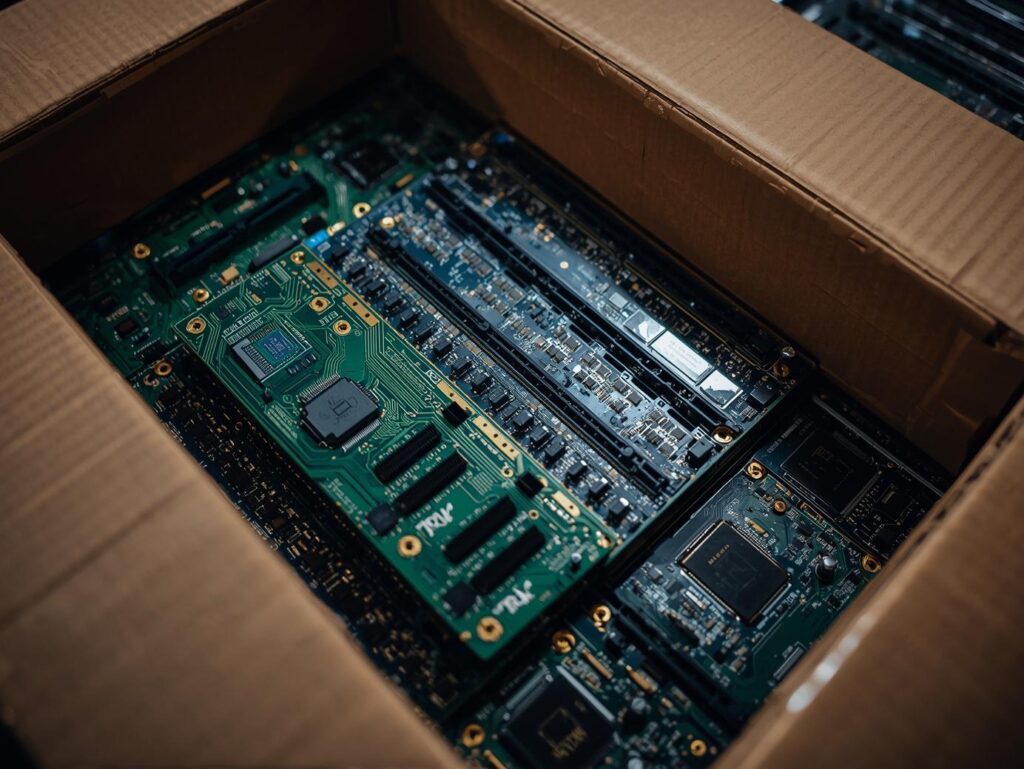
E-Waste Motherboard Specialists: How to Sell Computer Boards by the Grade
The problem most scrappers face is the “one-price-fits-all” trap. You spend your weekend carefully dismantling towers and laptops, but when you get to the yard, they give you the same price for a high-grade server board that they give for a low-grade power supply board. It is a losing game to put in the labor of “delidding” and “de-populating” only to have the value averaged down by the junk. You see the gold-plated pins and the silver-bearing solder, but you are being paid as if it’s all just “shred” metal. This lack of specialized grading keeps your profit margins thin and your truck half-empty.
The solution is to find an “E-Waste Board Sort Buyer.” These are specialized companies that don’t look at a board as a single unit. They look at the “pop” – that’s the concentration of integrated circuits (ICs), capacitors, and precious metal plating. They pay by the specific grade, often offering ten times the price for high-grade material compared to the low-grade stuff. When you find a specialist, you move from being a “junk man” to being a “precious metals recovery agent.”
What is an E-Waste Board Specialist?
In the secondary market, these buyers are known as “processors” or “aggregators.” In the trade, they are often classified under NAICS 562920 (Materials Recovery Facilities). They aren’t just buying metal; they are buying a “chemical signature.” They sort boards into very specific categories because they sell them to “smelters” who use chemical baths to extract gold, palladium, silver, and copper.
- High Grade: Motherboards from old PCs (pre-Pentium 4 are the best), laptop boards, and “Server” boards. These have the highest concentration of gold.
- Mid Grade: Peripheral cards (sound, video, network), and “Telecom” boards from old phone systems.
- Low Grade: Power supply boards, monitor boards, and “brown” boards from cheap consumer electronics like VCRs or toy remotes.
A specialist will have a price sheet that lists 20 or 30 different grades of boards. They don’t guess; they know the “yield” of every board they buy.
How to Find and Work with a Board Specialist
You won’t find these buyers at the local dump. You need to look for “E-Waste Refiners” or “IT Asset Disposition” (ITAD) companies. While some large companies like CashForComputerScrap or Boardsort operate nationally via mail-in programs, there are local specialists in every major city.
When you call them, use the language of the trade. Don’t ask what they pay for “computers.” Ask for their “current board-sort price list.” Tell them you are “aggregating and pre-sorting” your material. This tells them you know the difference between a “Large Socket” motherboard and a “Small Socket” one. If they see that you have already removed the heat sinks (aluminum), the batteries (hazardous), and the large steel brackets (ferrous), they will give you the “Clean Board” price, which is significantly higher.
Starting an E-Waste Sorting Business
If you want to grow your business, you can become a local “Board Sorter.” You become the person who buys the “mixed e-scrap” from other scrappers and does the “clean and sort” work before sending it to the big refiner.
The Setup:
- The Space: You need a dry, well-lit area with several large “Gaylord” boxes (heavy-duty pallet-sized cardboard boxes). Each box is for a different grade of board.
- The Tools: You need a high-quality electric screwdriver, a set of pliers, and a “de-soldering” station if you plan to pull high-value IC chips. You also need a scale that is accurate to the tenth of a pound.
- The Licenses: You’ll need a general business license, but you also need to look into “R2” or “e-Stewards” certification if you plan to handle large corporate contracts. These certifications prove you handle the material safely and responsibly.
- The Payout: This is about “up-grading.” You might buy a box of mixed boards for $1.00 a pound. After two hours of sorting and cleaning, you might find that 20% of the load is “High Grade” worth $4.00 a pound, and the rest is “Mid Grade” worth $2.00 a pound. That “lift” in value is your profit.
The “Secret Sauce”: The “Fingers and Flats” Tip
I want to give you a tip that will help you find the most “concentrated” gold on any board. This is what the specialists are looking for when they grade your load.
Did you know? The gold isn’t just in the pins. It is also in the “fingers” (the edge connectors that plug into a slot) and the “flats” (the flat IC chips).
The Tip: Before you throw a board in the bin, check the IC chips – those little black rectangles. If they have a “gold cap” or are ceramic (purple or white), they are extremely high-value. But here is the pro trick: Use a pair of heavy snips to cut the “Gold Fingers” off the edge of the boards. In the trade, “Gold Fingers” are a separate category. While the board might be worth $2.00 a pound, the fingers alone can be worth $50.00 to $80.00 a pound. By cutting them off and selling them separately, you are “cherry-picking” the highest value from your scrap.
Integrity and Data Security
In the e-waste business, honesty is about more than just the weight on the scale. It is about “Data Destruction.” If you are picking up computers from a business or a private home, you are also picking up their private lives – bank records, photos, and passwords.
Always play it straight. If you get a computer with a hard drive, you must either wipe it using “DoD-level” software or physically destroy the drive with a drill or a shredder. Tell your customers, “I destroy all data drives before recycling.” This builds trust. If you are known as the “Safe E-Waste Guy,” you will get the high-value commercial contracts that the “fly-by-night” scrappers will never see.
Always check your local laws. Some states have “E-Waste Disposal Acts” that require you to register as a collector. These laws often provide “rebates” or “credits” for every pound of e-waste you keep out of the landfill. It’s a way to get paid by the state and the buyer at the same time.
***
Ulysses’ Safety Reminder: E-waste is full of “hidden” dangers. Older monitors (CRTs) can hold a massive electrical charge even when unplugged – they can literally kill you if you touch the wrong part. Also, many circuit boards contain lead, cadmium, and brominated flame retardants. Never burn e-waste to “get the gold.” The fumes are incredibly toxic. Always wear gloves to protect against sharp fiberglass edges and lead dust. Stay sharp and stay safe.
Specialist Scrap Buyers
Knowledge is the only thing that doesn’t weigh down the truck.
- Gold and Silver Refiners: Skip the pawn shops and jewelry stores to sell directly to the industrial furnaces for high-percentage payouts.
- Plastic Polymer Brokers: Turn the “waste” casings from appliances into industrial feedstock like ABS and HDPE.
- Textile Rag Houses: Move bulk clothing and linens by the ton for export, vintage resale, or industrial wiping rags.
- Automotive Core Buyers: Stop selling starters and alternators for scrap weight and start selling them as rebuildable units.
- E-Waste Motherboard Specialists: Move beyond “shred” prices by grading circuit boards based on their gold and precious metal content.
- Lead-Acid Battery Wholesalers: Aggregate your car and industrial batteries into pallets to get the top-tier lead prices.
- Catalytic Converter Specialists: Use serial numbers and PGM assays to get paid for the platinum, palladium, and rhodium inside the shell.
- Cardboard and Paper Pulp Brokers: Manage high-volume fiber by baling cardboard to “Mill-Spec” standards for a steady paycheck.
- Used Oil and Chemical Recovery Firms: Turn a messy liability into “liquid gold” by selling bulk fluids for re-refining.
- Pallet Brokers: Turn used wood into a high-velocity business by sourcing and repairing GMA-standard shipping pallets.
- Glass Cullet Buyers: Sort glass by color and purity to supply the bottling and fiberglass industries.
- Appliance Parts Liquidators: Harvest the control boards and motors from “white goods” to sell to the repair industry.
- Specialty Non-Ferrous Smelters: Identify and sell high-temp “super-alloys” like Titanium, Inconel, and Monel by their specific chemistry.
- Used Tire Casing Buyers: Grade your used rubber to find “buildable” carcasses for the retread industry.
- Drum and Tote Reconditioners: Sell your clean 55-gallon barrels and IBC tanks to firms that wash and re-certify them for reuse.