
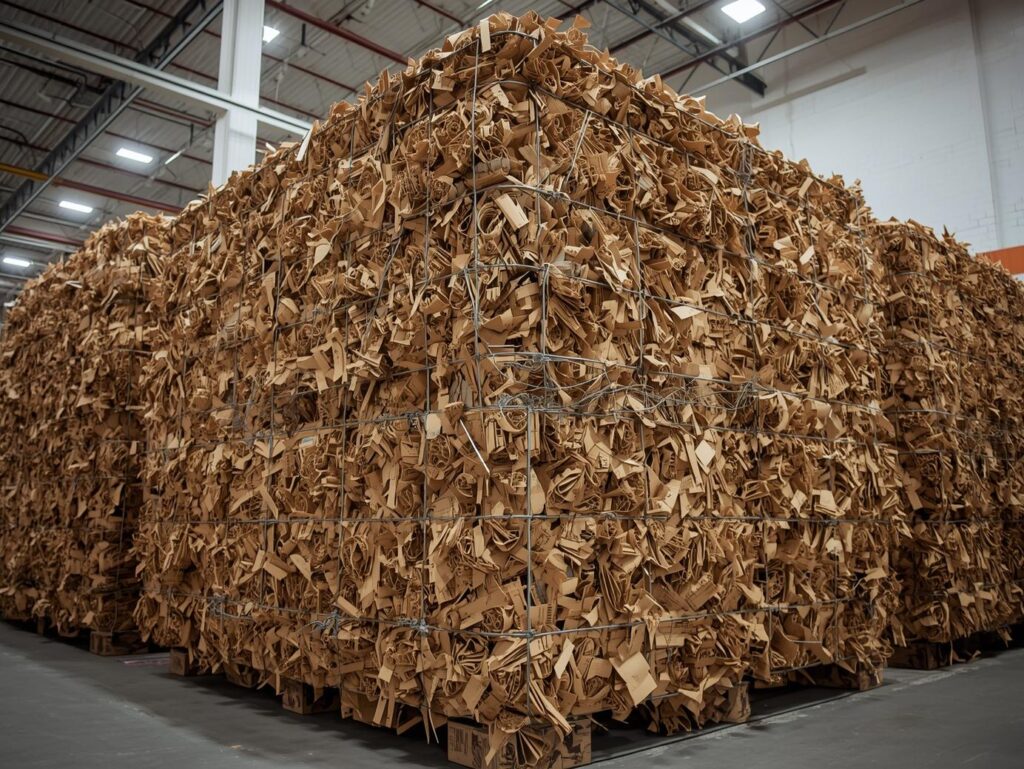
The Cardboard and Paper Pulp Broker: Moving High-Volume Fiber
We’re moving away from the “spark and clank” of the metal bins and looking at something a bit softer, but just as heavy when it comes to the bottom line. I’m talking about fiber – specifically, Old Corrugated Containers, or what most folks call cardboard.
The trouble with the secondary market is that people get blinded by the high price of copper and gold. They walk right past a mountain of cardboard because it only pays a few cents a pound. But if you want to be a master of the yard, you have to look at “The Big Fill.” Cardboard is everywhere. It is the packaging of the world. While you are hunting for that one lucky copper find, you could be moving tons of fiber that provide a steady, predictable paycheck every week. If you are just throwing your boxes in a dumpster, you are paying a waste company to take away your inventory.
The solution is to find a Paper Pulp Broker or an OCC (Old Corrugated Containers) Aggregator. These are the buyers who sit between the retail world and the massive paper mills. They don’t want a “truckload of boxes”; they want “Mill-Spec Bales.” When you learn how to process fiber the way the mills want it, you stop paying for a dumpster and start getting paid for your volume.
What is a Paper Pulp Broker?
In the trade, a paper pulp broker is a wholesaler who manages the “fiber stream.” They fall under NAICS 423930 (Recyclable Material Merchant Wholesalers). Their job is to supply the big paper mills with enough raw material to keep the machines running 24/7. These mills take your old boxes, chew them up in a giant vat of water and chemicals, and turn them back into new “linerboard” and “fluting” for the next generation of shipping containers.
A broker is not a “drop-off center.” They are a logistics partner. They buy by the ton, and they expect the material to be “densified” and “clean.” There are three main grades of fiber a broker looks for:
- OCC (Old Corrugated Containers): This is the standard brown cardboard box. It has the “wavy” layer in the middle. This is the highest-demand fiber in the trade.
- Mixed Paper: This includes mail, magazines, and office paper. It has a lower value because the fibers are shorter and weaker, making the new paper less sturdy.
- ONP (Old Newsprint): Newspapers. This market is shrinking, but there is still a specialized buyer for it in the insulation and animal bedding industries.
How to Prepare and Sell Your Fiber
You won’t find a broker by looking for a local scrap yard. You need to look for “Waste Paper Merchants” or “Recycling Wholesalers.” Companies like WestRock, International Paper, or Pratt Industries are the giants, but there are independent brokers in every region who buy from smaller collectors.
When you call a broker, don’t ask for a “price per box.” Ask for their “Current Mill-Gate Price for Baled OCC.” To get the top dollar, you need to understand “Mill-Spec” requirements.
The most important rule is No Contamination. If your cardboard is soaked in oil, covered in wax (like produce boxes), or has food waste (like pizza boxes), it is considered “prohibit” material. A broker will downgrade an entire 40,000-pound load if they find too much food waste in it.
You also cannot sell loose cardboard to a broker. It costs too much to ship “air.” You must use a “Vertical” or “Horizontal” baler to compress the cardboard into 800 to 1,200-pound cubes. Finally, these bales should be tied with heavy-gauge “Baling Wire” (ferrous wire), not plastic twine or rope. The mills have magnets to pull the wire out, but plastic melts and ruins the pulp.
Starting a Cardboard Brokerage and Route
If you want to build a business around fiber, you don’t need to be a “picker” in the traditional sense. You need to be a service provider. You become the person who helps small businesses solve their “cardboard problem.”
The Setup:
- The Route: Focus on “Small-Box” retail, furniture stores, and industrial parks. These places generate mountains of cardboard but aren’t big enough for the massive waste companies to give them a “rebate.” Offer to pick up their un-crushed boxes for free. You save them the dumpster fee, and you get the material for zero cost.
- The Equipment: You need a “Vertical Baler.” You can often find these used for a few thousand dollars. You also need a flatbed truck or a trailer with a liftgate to move the finished bales.
- The Warehouse: You need a dry space. If cardboard gets wet, it starts to rot and lose its “burst strength.” Wet bales are also a major fire hazard because they can generate heat as they decompose. Keep your fiber dry to keep your price high.
- The Payout: This is a volume game. You collect for free, bale the material at your shop, and sell it to the broker for the current market rate. When you move 100 tons a month, you have a professional, low-risk business.
The “Secret Sauce”: The Flute and Liner Test
I want to give you a tip that will help you tell “High-Value OCC” from “Junk Fiber” at a glance. This is how you avoid wasting space in your baler with low-value material.
Did you know? Not all “brown boxes” are cardboard. Some are “Solid Fiberboard” (like a cereal box), and some are “Wax-Impregnated.” If you mix these into an OCC bale, the broker will dock your pay for “out-throws.”
The Tip: Use the Tear Test. Tear the edge of the box. If you see the “corrugation” (the wavy paper “flutes” between two flat “liners”), it is OCC. Then, do the Wax Check. Take your fingernail and scrape the surface of a shiny box. If a waxy residue comes off, it is a “Wax-Coated” box used for shipping cold meat or produce. These are “Trash” in the fiber world. They cannot be pulped because the wax doesn’t melt in water. By keeping the wax and the solid fiberboard out of your OCC bales, you guarantee the “Mill-Spec” quality that brokers will pay a premium for.
Integrity and the Long Game
In the fiber business, your reputation is built on “Load Purity.” A broker is trusting you that the middle of your 1,000-pound bale isn’t full of bricks, wet trash, or plastic. If you try to cheat the weight, you will be caught when that bale hits the pulper at the mill, and you will never get another contract.
Play it straight. If a load gets wet in the rain, don’t try to hide it. Tell the broker, “This bale is wet, mark it accordingly.” They will appreciate the honesty and will be more likely to work with you when the market gets tight. In the secondary market, the person who provides consistent, clean feedstock is the one who gets the top-tier pricing.
Always check your local fire codes. Storing large amounts of baled cardboard is a significant fire risk. You will likely need a sprinkler system or specific “fire-aisle” spacing in your warehouse to stay legal and safe.
***
Ulysses’ Safety Reminder: Balers are powerful machines that use thousands of pounds of hydraulic pressure. Never, ever bypass the safety interlocks on a baler door. I’ve seen good men lose limbs because they were in a rush to “top off” a bale. Also, be careful of “Wire Snaps.” When you are tying off a bale, that wire is under extreme tension. Always wear eye protection. A snapped wire can take an eye out before you even hear it pop. Stay sharp and stay safe.
Specialist Scrap Buyers
Knowledge is the only thing that doesn’t weigh down the truck.
- Gold and Silver Refiners: Skip the pawn shops and jewelry stores to sell directly to the industrial furnaces for high-percentage payouts.
- Plastic Polymer Brokers: Turn the “waste” casings from appliances into industrial feedstock like ABS and HDPE.
- Textile Rag Houses: Move bulk clothing and linens by the ton for export, vintage resale, or industrial wiping rags.
- Automotive Core Buyers: Stop selling starters and alternators for scrap weight and start selling them as rebuildable units.
- E-Waste Motherboard Specialists: Move beyond “shred” prices by grading circuit boards based on their gold and precious metal content.
- Lead-Acid Battery Wholesalers: Aggregate your car and industrial batteries into pallets to get the top-tier lead prices.
- Catalytic Converter Specialists: Use serial numbers and PGM assays to get paid for the platinum, palladium, and rhodium inside the shell.
- Cardboard and Paper Pulp Brokers: Manage high-volume fiber by baling cardboard to “Mill-Spec” standards for a steady paycheck.
- Used Oil and Chemical Recovery Firms: Turn a messy liability into “liquid gold” by selling bulk fluids for re-refining.
- Pallet Brokers: Turn used wood into a high-velocity business by sourcing and repairing GMA-standard shipping pallets.
- Glass Cullet Buyers: Sort glass by color and purity to supply the bottling and fiberglass industries.
- Appliance Parts Liquidators: Harvest the control boards and motors from “white goods” to sell to the repair industry.
- Specialty Non-Ferrous Smelters: Identify and sell high-temp “super-alloys” like Titanium, Inconel, and Monel by their specific chemistry.
- Used Tire Casing Buyers: Grade your used rubber to find “buildable” carcasses for the retread industry.
- Drum and Tote Reconditioners: Sell your clean 55-gallon barrels and IBC tanks to firms that wash and re-certify them for reuse.