
Lead-Acid Battery Wholesalers: Selling by the Pallet for Maximum Profit
If you have been doing this for a while, you know that lead-acid batteries are the bread and butter of a consistent route. Every car, truck, boat, and forklift has one, and eventually, they all fail.
The mistake most people make is taking three or four batteries to the local scrap yard every time they find them. You are getting the “retail” scrap price – the lowest possible payout. When you factor in the gas and the time spent hauling those heavy blocks of lead and acid, your actual profit is razor-thin. It feels like you are doing all the back-breaking labor just to keep your head above water. You see the massive stacks of batteries at the big shops and you know there is a better way to play the game, but you aren’t sure how to jump from “collector” to “wholesaler.”
The solution is to find a specialized Lead-Acid Battery Wholesaler or a “Secondary Lead Smelter” direct buyer. These are the companies that buy batteries by the pallet, not by the piece. They don’t look at a battery as a part; they look at it as a “core” for the lead industry. By aggregating your batteries and selling in bulk, you can bypass the middleman and get paid the same “tier-one” prices that the big auto parts stores get.
What is a Lead-Acid Battery Wholesaler?
In the secondary market, these buyers are the primary link in the “closed-loop” recycling system. Lead-acid batteries are the most recycled consumer product in the world – over 99% of the lead in a new battery comes from an old one. In the trade, these buyers are often listed under NAICS 423120 (Motor Vehicle Supplies and New Parts Merchant Wholesalers) or NAICS 423930 (Recyclable Material Merchant Wholesalers).
A wholesaler isn’t just a scrap dealer. They are often “Core Brokers.” They buy spent batteries (cores) and sell them directly to the smelters who melt the lead down to make new grids and posts. They handle three main types of lead-scrap:
- SLI Batteries: These are your standard Starting, Lighting, and Ignition batteries from cars and trucks.
- Industrial/Deep Cycle: These come from forklifts, golf carts, and floor scrubbers. They are much heavier and have thicker lead plates.
- Stationary/UPS: These are found in data centers and cell towers as backup power. They are often “sealed” (AGM or Gel) and carry a different price point.
How to Find and Work with a Battery Wholesaler
You won’t find these guys at a retail storefront. You need to look for “Battery Distributors” or “Core Recovery Services” in industrial zones. Companies like Interstate Batteries, Gopher Resource, or RSR Corp are the big players, but there are regional wholesalers in every state who buy from independent collectors.
When you call them, don’t ask for the “scrap price per battery.” Ask for their “Pallet Price for Mixed SLI Cores.” To get the top dollar, you need to present your load the way a pro does:
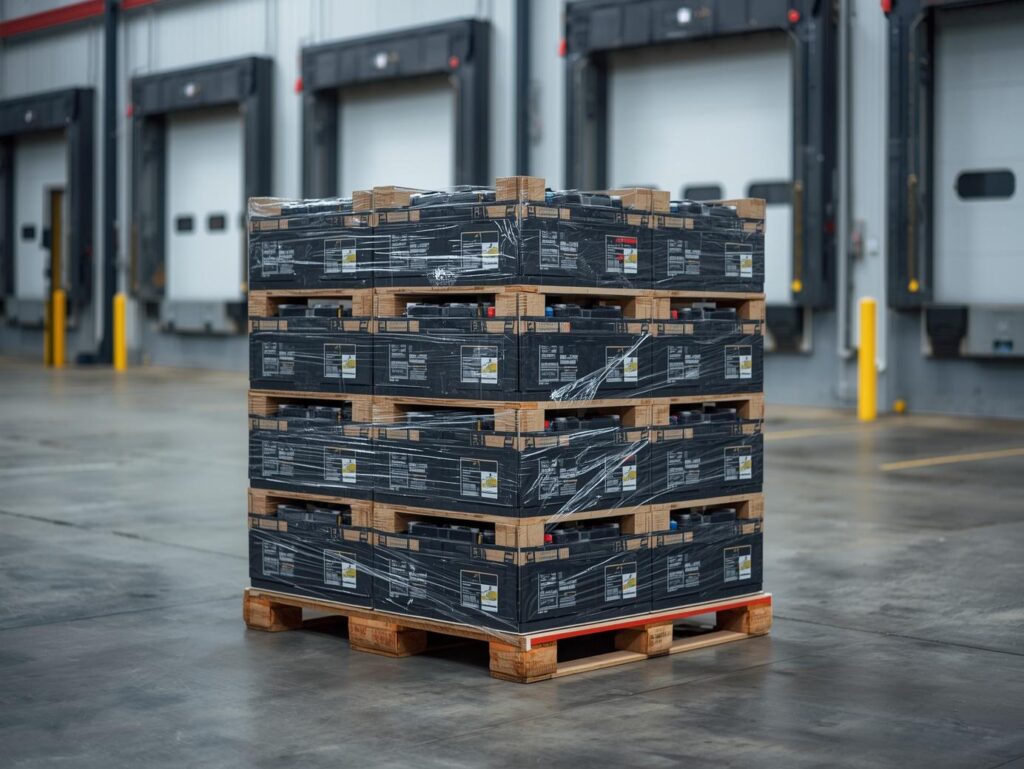
- Palletized: Batteries should be stacked on a sturdy wood pallet (usually 3 to 4 layers high).
- Layered: Place a sheet of thick cardboard or “honeycomb” plastic between each layer to prevent the terminals from shorting out or the casings from cracking.
- Shrink-Wrapped: The entire pallet must be wrapped tightly so it doesn’t shift during transport.
A wholesaler wants a “clean” pallet that they can pick up with a forklift and put straight onto a semi-truck. If you do that work for them, they will pay you the “wholesale” rate, which can be 20% to 30% higher than the local yard.
Starting a Battery Core Brokerage
If you want to scale up, you can become the “Core Man” for your area. You become the person who collects from all the small garages, scrap metal guys, and shade-tree mechanics.
The Setup:
- The Space: You need a concrete-floored warehouse or a covered pad. You cannot store batteries on bare dirt because of the risk of acid leaks.
- The Equipment: You need a pallet jack, a heavy-duty scale (usually a “Floor Scale” that can handle 3,000 lbs), and a supply of pallets and shrink wrap.
- The Licenses: This is the big one. Because batteries contain lead and sulfuric acid, they are considered “Hazardous Material” if they are broken. You will need an EPA ID number if you store more than a certain amount (usually 2,200 lbs) at any one time. You also need to follow “Universal Waste” regulations.
- The Payout: This is a “spread” business. You buy batteries for $5 to $8 a piece from the public, palletize them, and sell them to the smelter for the “lead-weight” price, which might come out to $12 or $15 a battery. When you move 10 pallets a week, that’s a professional income.
The “Secret Sauce”: The “Reconditioned” Resale Tip
I want to give you a tip that will double your money on about 10% of the batteries you find. This is how the real masters of the yard make the “bonus” profit.
Did you know? Many batteries that get “scrapped” aren’t actually dead. They are just “sulfated” or have been sitting for too long.
The Tip: Before you throw a battery on the scrap pallet, check the “Date Code” and the “Voltage.”
- The Date Code: Most batteries have a sticker or a heat-stamp with a letter and a number (A-L for the month, and a number for the year). If a battery is less than two years old, it’s a candidate for resale.
- The Voltage: Use a basic multimeter. If the battery reads above 10 volts, it often just needs a slow “trickle charge” and a “desulfation” cycle.
A “Reconditioned” battery can sell for $40 to $60 to someone looking for a cheap replacement for a farm truck or a beater car. That is four times what you’d get for it as scrap lead.
Integrity and Environmental Safety
In the lead business, your reputation is tied to how you handle the acid. If you are the guy who “pours the acid out” to make the batteries lighter for the scale, you are a criminal and a fool. Not only are you destroying the environment, but you are also ruining the lead. Smelters want the acid in the battery because they have the systems to neutralize it and recycle the plastic. If you bring in “dry” batteries, most wholesalers will either reject them or dock your pay.
Always play it straight. If a battery is leaking, put it in a “leaker box” (a plastic tub with baking soda) and tell the buyer. They will appreciate your honesty and your care for their facility.
Check your local laws regarding “Core Charges.” In many states, when someone buys a new battery, they pay a $15 to $20 deposit. If they don’t bring the old one back, they lose that money. You can offer to pick up those “lost” cores from people for a small fee. You are helping them clear clutter while you build your pallet.
***
Ulysses’ Safety Reminder: Lead-acid batteries are dangerous. They produce hydrogen gas when charging or discharging, which is highly explosive. Never smoke or create sparks near your battery stacks. Also, the “lead” in batteries is a “neurotoxin.” Always wear gloves and wash your hands thoroughly before eating or smoking. If you get acid on your skin, use plenty of water and baking soda to neutralize it immediately. Stay sharp and stay safe.
Specialist Scrap Buyers
Knowledge is the only thing that doesn’t weigh down the truck.
- Gold and Silver Refiners: Skip the pawn shops and jewelry stores to sell directly to the industrial furnaces for high-percentage payouts.
- Plastic Polymer Brokers: Turn the “waste” casings from appliances into industrial feedstock like ABS and HDPE.
- Textile Rag Houses: Move bulk clothing and linens by the ton for export, vintage resale, or industrial wiping rags.
- Automotive Core Buyers: Stop selling starters and alternators for scrap weight and start selling them as rebuildable units.
- E-Waste Motherboard Specialists: Move beyond “shred” prices by grading circuit boards based on their gold and precious metal content.
- Lead-Acid Battery Wholesalers: Aggregate your car and industrial batteries into pallets to get the top-tier lead prices.
- Catalytic Converter Specialists: Use serial numbers and PGM assays to get paid for the platinum, palladium, and rhodium inside the shell.
- Cardboard and Paper Pulp Brokers: Manage high-volume fiber by baling cardboard to “Mill-Spec” standards for a steady paycheck.
- Used Oil and Chemical Recovery Firms: Turn a messy liability into “liquid gold” by selling bulk fluids for re-refining.
- Pallet Brokers: Turn used wood into a high-velocity business by sourcing and repairing GMA-standard shipping pallets.
- Glass Cullet Buyers: Sort glass by color and purity to supply the bottling and fiberglass industries.
- Appliance Parts Liquidators: Harvest the control boards and motors from “white goods” to sell to the repair industry.
- Specialty Non-Ferrous Smelters: Identify and sell high-temp “super-alloys” like Titanium, Inconel, and Monel by their specific chemistry.
- Used Tire Casing Buyers: Grade your used rubber to find “buildable” carcasses for the retread industry.
- Drum and Tote Reconditioners: Sell your clean 55-gallon barrels and IBC tanks to firms that wash and re-certify them for reuse.